Youtiao in Beijing: Breakfast Pairings, Freshness, and How to Order
A practical guide to youtiao in Beijing: fresh fried dough texture, soy milk and breakfast-bowl pairings, ordering cues, and how it differs from jiaoquan.
Compare long youtiao, flat youbing, and sugar-topped tangyoubing, with menu words, texture clues, breakfast pairings, and practical ordering questions.
At a Beijing breakfast counter, a long golden stick and a broad fried cake may sit beside each other, both waiting for a bowl of soy milk. A third piece has a noticeably darker, sweet surface. These are not simply different sizes of the same order: youtiao, youbing, and tangyoubing give you different shapes, textures, and levels of sweetness.
This comparison is for choosing what to eat, not reproducing a shop's dough recipe. Our Beijing youtiao guide covers the fried stick itself; here the useful question is what changes when you choose a flat cake or a sugar-topped version instead.
The three names are yóutiáo (油条), yóubǐng (油饼), and tángyóubǐng (糖油饼).
The character tang (糖) is the important addition in the last name: it signals sugar. Bing is a broad word for cakes and flatbreads, not a promise of a Western-style pancake. A translation such as “fried bread” may describe all three too loosely to help you choose.
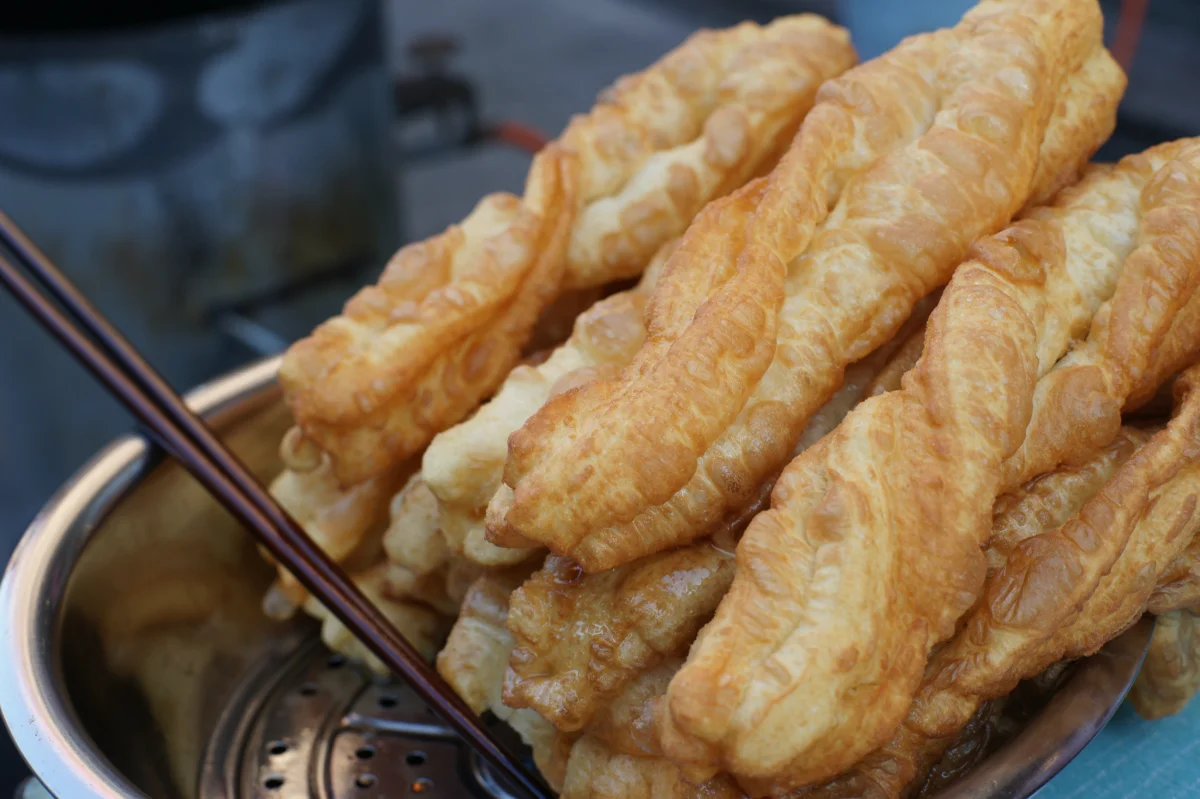
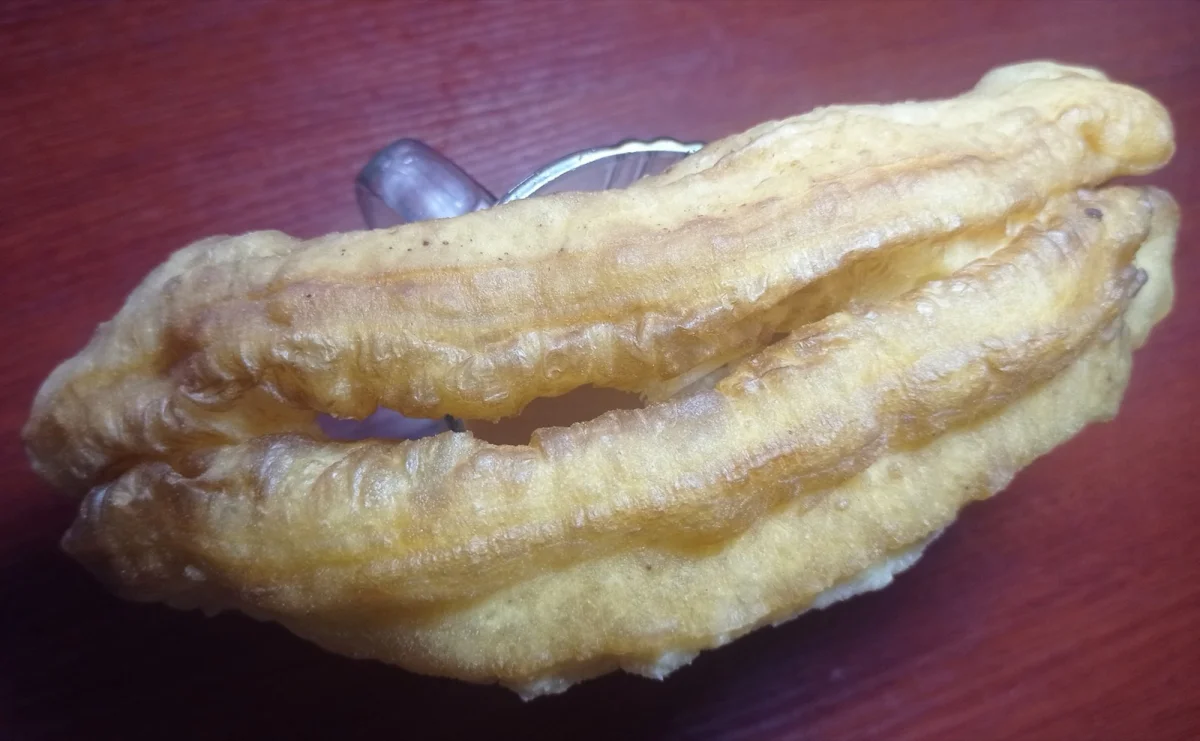
Youtiao gives you an elongated piece with an airy interior and a fried outer surface. It is normally treated as a savoury or lightly salted breakfast food, not as a sugar-coated doughnut. Pulling the joined strips apart exposes more of the inside; breaking off a small piece is easier than trying to dunk the full length into a bowl.
Choose it when you want a piece you can divide, share, or briefly dip. A quick dip changes only the outside; leaving it in the bowl makes it much softer. Neither is compulsory. Taste a piece on its own first if you want to judge the dough rather than the drink.
The joined-strip shape is also the focus of our guide to how youtiao is made. Length alone does not tell you how much dough is in an order: a very puffed stick and a denser one can look equally substantial.
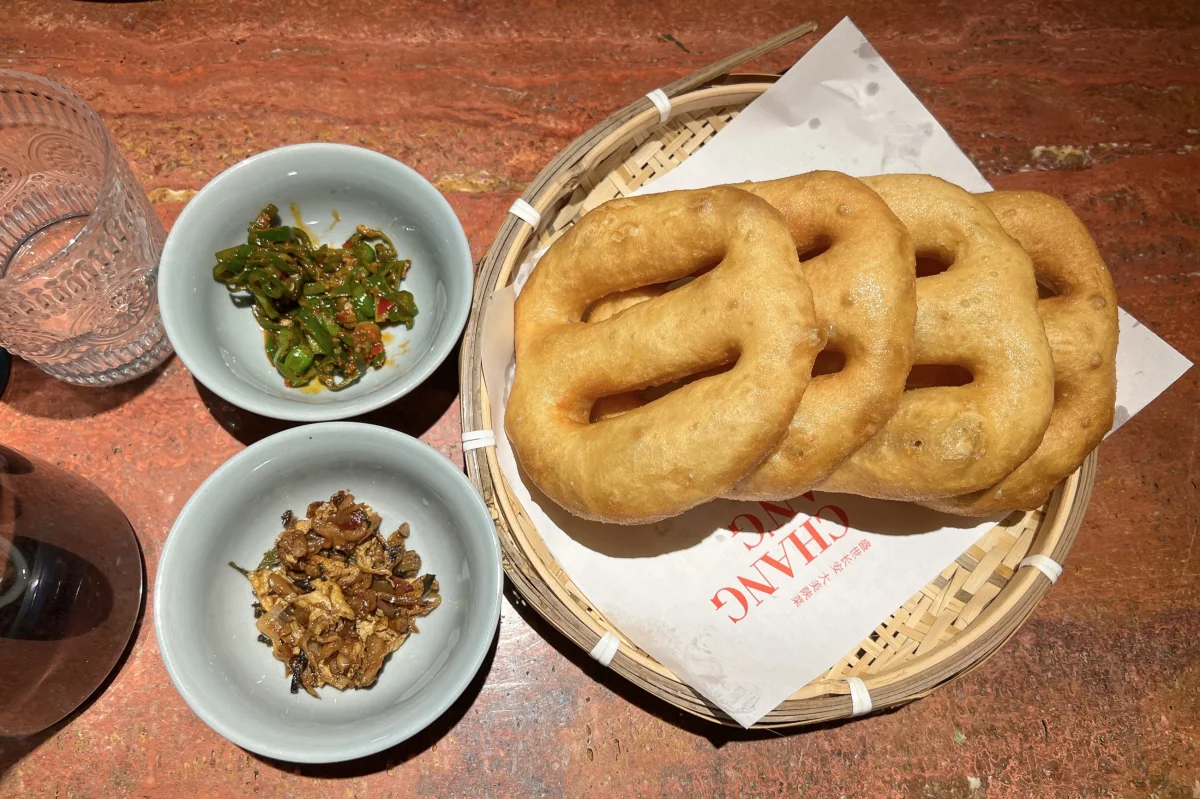
In an old-Beijing breakfast setting, youbing usually points you toward a flat fried cake rather than long sticks. Its broader surface lets you take a bite across the fried edge and the softer dough beneath. Some examples have openings or cuts, while others are less regular in shape. Do not use the number of holes as a strict identification test.
The word travels beyond Beijing and does not identify one fixed regional recipe. The gallery includes a youbing plate photographed at CHANG AN G in Beijing as a regional restaurant example. It shows why the name alone is not enough; it is not a claim that every Beijing breakfast counter serves that version, those side dishes, or that portion.
If you specifically want the non-sweet choice, ask zhège shì bú tián de ma? (这个是不甜的吗?, “Is this the non-sweet one?”). That confirms taste, not a complete ingredient list. It is more reliable than assuming that a pale piece cannot contain sugar.
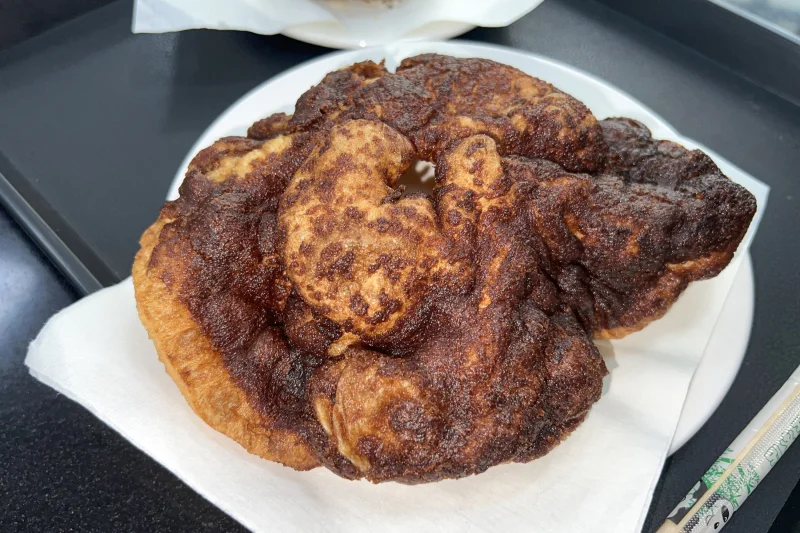
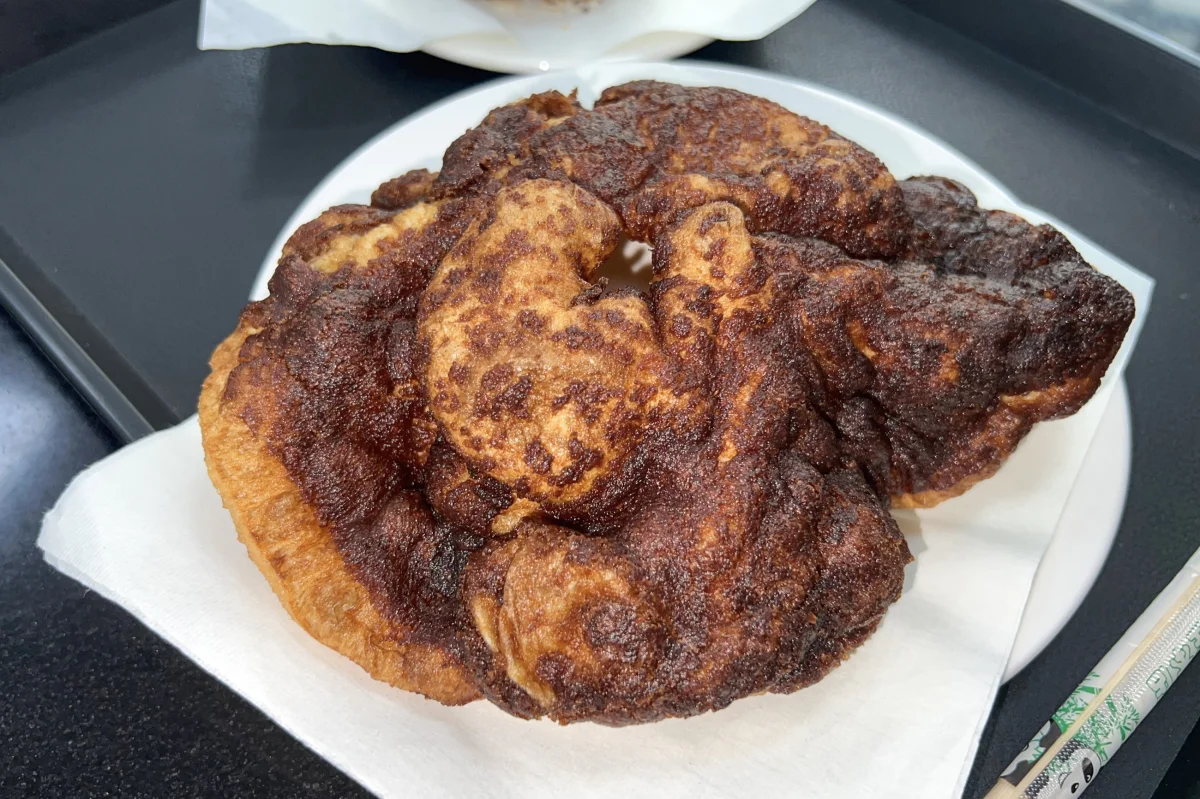
Beijing Tourism describes tangyoubing as a golden fried cake carrying a darker sugar-dough layer. Think of a sweet surface joined to a fried bread base, rather than a hollow pastry filled with syrup. Brown sugar is one documented version, including the cake shown in our first photograph; do not assume every seller uses the same sugar or ratio.
The interest is in the contrast: a sweet, more brittle surface against the softer cake. A darker top therefore does not automatically mean the whole piece is burnt. Equally, colour cannot prove that it was fried well. Ask for a recently cooked piece and judge its aroma and texture when it is comfortable to eat.
Some shops offer single- and double-sugar choices. Beijing Tourism has documented a thicker sugar option at a specific breakfast shop, but that is not a citywide menu rule. If the counter offers dan tang (单糖) or shuang tang (双糖), ask what changes: the amount of sugar dough, the overall size, or both. “Double” does not tell you a standard weight.
Soy milk, doujiang (豆浆), is a familiar partner for fried dough. With tangyoubing, an unsweetened bowl leaves the cake to supply the sweetness. With plain youtiao, either sweetened or unsweetened soy milk can work; choose your preference rather than treating one combination as a rule.
A savoury bowl of doufunao gives another contrast to a sweet fried cake. Beijing Tourism explicitly describes the doufunao-and-tangyoubing pairing. This is a way to balance tastes at breakfast, not a requirement to buy both a sweet drink and a savoury bowl with every cake.
Do not confuse soy milk with fermented douzhi. And if you want the thin, crisp ring often associated with douzhi, that is jiaoquan, not a round youbing. Our jiaoquan and youtiao comparison explains that separate choice.
Start with one fried item and one bowl, then add more if the portion is smaller than you expected. Two people who want to compare could share a youtiao and a tangyoubing rather than order a full serving of every fried option. Check whether the cake is sold whole, cut, or by a serving before paying.
For takeaway, ask how soon the food should be eaten and how the shop packs it. Fried dough loses its original contrast as it sits; steam trapped in a closed bag can soften the surface. Buying a smaller amount near the time you plan to eat is more useful than expecting a long walk across the city to preserve the first bite.
The simplest decision is a texture-and-sweetness choice: long, airy youtiao; a broad youbing whose exact style you confirm; or tangyoubing for the extra sugar surface. Browse the Beijing breakfast collection for the bowls and other small dishes that can make the rest of the meal.
Ordering and portion suggestions are editorial guidance. This article does not reproduce historical shop prices, opening hours, or claim that every counter offers each variation.
Photographs illustrate the named foods, not a current restaurant review. N509FZ: brown-sugar tangyoubing and regional youbing at CHANG AN G in Beijing, CC BY-SA 4.0. Popo le Chien: Youtiao, CC0. SarKaLay: individual youtiao in a Myanmar food context, CC BY-SA 4.0; this illustrates the fried-dough shape, not a Beijing restaurant. Images are resized for display.
Comments (0)